

Fruit Battery
Fruit Battery
Couldn't load pickup availability
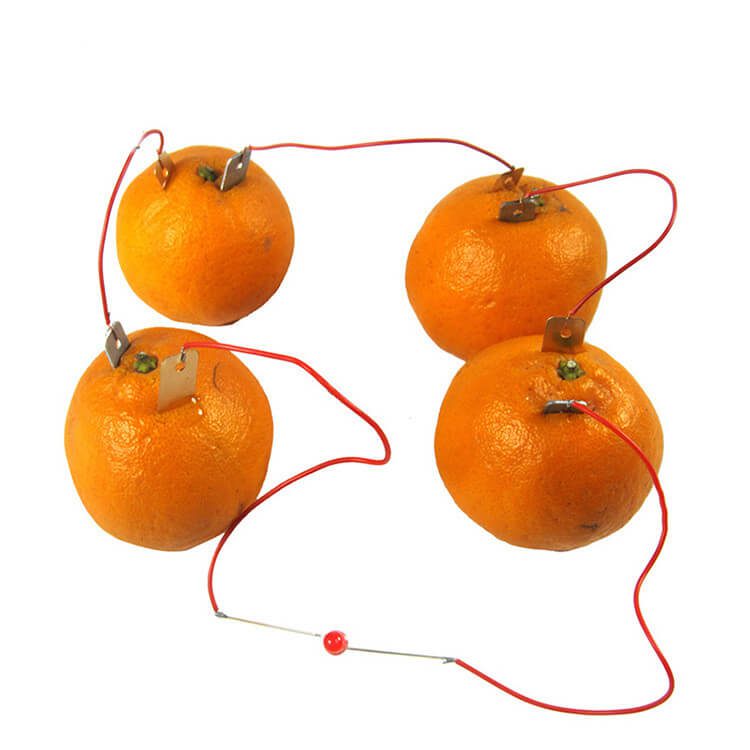
Description
Explore batteries with your child! Place the electrodes in series into four pieces of potato, tomato, or water solution to see the light go on.
Explanation for parents:
A fruit battery, often demonstrated using a lemon, works on the same principles as a regular battery, converting chemical energy into electrical energy through an electrochemical reaction. It's a type of "voltaic cell."
Electrochemical Process:
-
Oxidation at the Anode (the Zinc): The zinc electrode has a stronger tendency to lose electrons than the copper electrode. When placed in the acidic fruit juice, the zinc atoms react with the acid. This reaction causes zinc atoms to give up two electrons each and turn into positively charged zinc ions (). These zinc ions dissolve into the fruit juice, leaving the two electrons behind on the zinc electrode. This loss of electrons is called oxidation, and the zinc electrode is the anode (the negative terminal.
-
Reduction at the Cathode (the Copper): The electrons that are now on the zinc electrode are negatively charged and repel each other. They "want" to move away. When the zinc and copper electrodes are connected by a wire, the electrons flow from the zinc (anode) to the copper (cathode). The copper, which has a higher "desire" for electrons, provides a place for them to go.
Explanation for children:
Electricity is carried by little workers, "electrons". Electrons run through metal. They like some metals more than others. When placed in fruit, they are able to escape the metal they like less (zinc - silver) and run towards the metal they like more (copper - golden). Wires connect the electrodes to help the little workers, electrons, run around and into the LED light.